Why lofts lose so much heat
Warm air rising is only part of the story. Here is where the heat actually goes, what it costs you, and the fixes that make a real difference.
The short version
- Heat leaves through the ceiling by conduction, radiation and air leakage, so depth alone is not the whole answer.
- Gaps around the hatch, downlights and pipes can cancel out otherwise good insulation.
- Damp or compressed insulation needs the cause found before anything new is fitted.
- A thermal camera survey shows where the heat is really going, rather than guessing from the age of the material.
Heat does not simply rise and disappear
The reason your loft matters is not that warm air floats upwards and vanishes. It is that the ceiling below the loft is usually the largest, flattest surface in the house, and heat moves through it constantly, whatever the air is doing.
Three things happen at once: conduction through the plasterboard, radiation across the cold space, and air leaking through gaps around pipes, downlights, the hatch and the eaves. Fix one of them and the other two keep working against you.
The gaps matter as much as the depth
A thick layer of insulation with a gap around it behaves like a thin one. Warm air finds the easiest route out, so an unsealed loft hatch, an open cylinder vent or a run of downlights can undo a whole roll of wool.
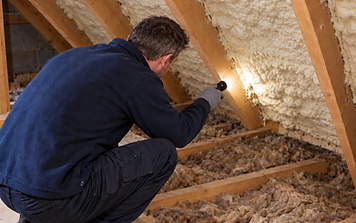
During a survey we use a thermal camera to show where the heat is actually leaving, rather than guessing from the age of the insulation.
Thin, compressed or damp
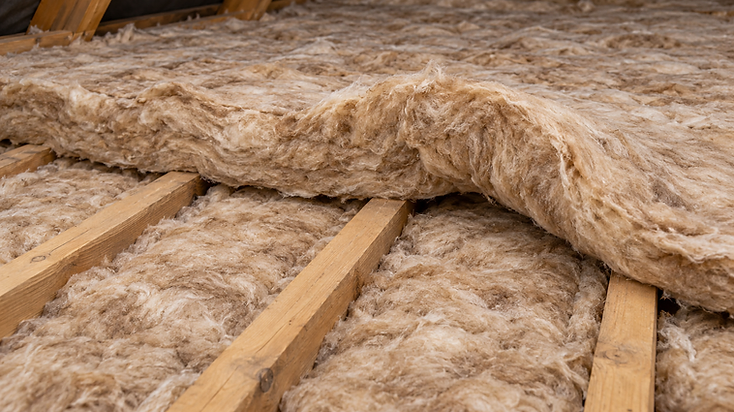
Insulation works by trapping air. When it is squashed, wet or decades old it loses much of that ability. Mineral wool that has been walked on, stored under boards or soaked by a leaking roof is doing very little.
If the material is dry and simply thin, topping it up is straightforward and inexpensive. If it is damp, the source of the water has to be found first, otherwise new insulation will fail in exactly the same way.
Cold bridging across the timbers
Timber joists are poor insulators, and a continuous run of them creates a thermal bridge from the warm ceiling to the cold loft. That is why a mineral wool job is usually improved by laying a second layer across the joists rather than only between them.
Where headroom is tight, a multifoil product such as SuperQuilt does the same job in a fraction of the thickness, fixed below or between the rafters.
What we would look at in your home
A useful survey treats the loft as a system: the depth and condition of the existing material, the airtightness of the ceiling, the ventilation at the eaves, any water staining, and whether the roof covering itself is sound.
If it is a straightforward refresh, we will tell you. If the insulation is fine and the draughts are the real problem, we will tell you that instead, and explain what to do about it.
Where to start
- Loft Insulation Refresh if the existing material is thin, compressed or past its best.
- SuperQuilt insulation for lofts with limited headroom or boarded areas.
- Book a home survey if you are not sure which of these applies to you.