What a proper insulation survey should include
A survey should end with a clear, written picture of what is wrong and what it costs to put right, including when the answer is to do very little.

The short version
- A good survey starts from the symptom you have noticed, not from a product.
- It covers insulation depth and condition, airtightness, ventilation and moisture in one visit.
- You should receive a written record: findings, what they mean, the recommendation, the cost and the exclusions.
- The honest conclusion is sometimes that very little work is needed, and you should be told that.
It should start with the problem
A useful survey begins with what you have noticed: the cold back bedroom, the mould in the corner, the upstairs that never warms up, or the report that flagged something on a house you are buying.
Those symptoms narrow the search. A survey that ignores them and works from a checklist of products will usually recommend whatever is on the checklist.
The loft, in detail
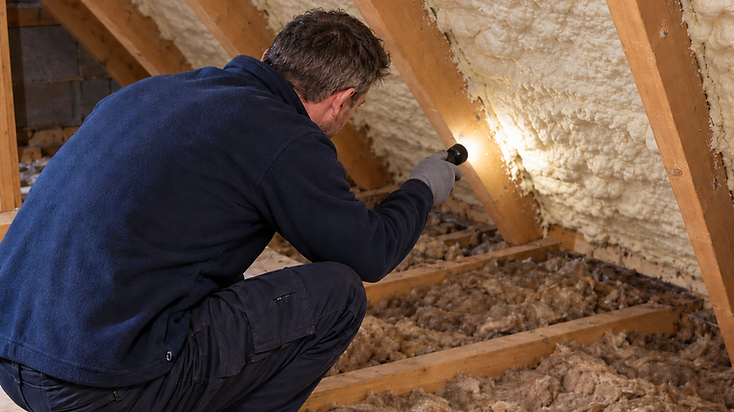
We check the depth and type of the existing insulation, whether it is dry, whether it has been compressed under boarding, and whether it covers the whole ceiling.
Then we look at the things that quietly undo it: the seal on the hatch, gaps around pipes and cables, downlight penetration, and whether the eaves vents are clear or blocked with insulation.
Air movement
Sealing a loft without thinking about ventilation is a common mistake. A tight ceiling under a cold roof can create condensation on the underside of the roof covering, which is why we check the air path at the eaves before recommending any change.
Moisture and the rest of the house
We take readings on walls and timbers, look for staining, and check the ventilation provision in bathrooms and kitchens. Water is the single most common reason insulation underperforms, and finding it is not optional.
What you should receive in writing
A proper survey ends with a document you can keep: what was found, what it means, what we recommend, what it costs and what we would not do. Photographs and thermal images help, especially where a problem is hidden.
If you are buying a property, that written record is often the most useful thing the survey produces.
Questions worth asking
- How did you establish what is in the loft, and did you look under the boards?
- What happens if you find something unexpected once work starts?
- Who carries out the work, and who is responsible if something goes wrong?
- What is not included in this price?
- What would you do first if this were your house?
The honest answer is allowed to be "not much"
Sometimes the survey finds that the insulation is sound, the draughts are minor, and the money is better spent on ventilation or a heating control. A survey that never reaches that conclusion is not really a survey.
We would rather tell you that than sell you work your home does not need.
Where to start
- Home insulation survey covers what we look at and how the visit runs.
- Condensation and heat-loss check if you want the heat loss picture proved visually.
- Book a survey if you have a specific room or problem in mind.